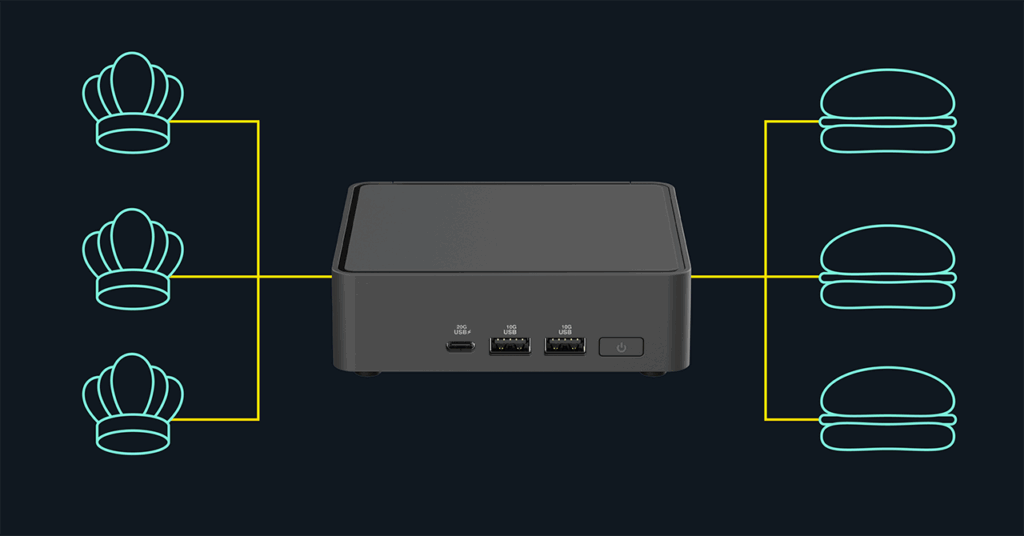


Edge server devices are physical edge computer hardware—like specialized Mini PCs or industrial edge computing gateways—deployed at the perimeter of the network to manage data collected from sensors and local machinery. These devices form the critical hardware layer for the seamless convergence of IoT and edge computing. Enabling data ingestion and low-latency processing at the same physical location where the information is created.
Edge computing devices are powering real-time decisions in more places than ever – from busy hospital wards to smart city infrastructure. These tools live right at the network edge, where they process data closer to where it’s created. That means faster results, lower latency, and less strain on cloud computing platforms.
What are the most common examples of edge devices used by B2B organizations?
The most common examples of edge devices used by B2B organizations are specialized hardware designed for continuous, reliable operation outside of traditional data centers. These devices vary based on the deployment environment but all share the core function of executing local processing (AI inference, data filtering) to achieve ultra-low latency.
Top Commercial Edge Device Examples:
- Industrial IoT Gateways: Rugged edge computer hardware, fanless mini computers used on smart factory floors to connect machinery, translate proprietary protocols, and run predictive maintenance analytics locally.
- Digital Signage Media Players: Compact, secure mini PCs VESA-mounted behind screens in retail QSR restaurants or corporate lobbies to guarantee continuous, synchronized high-resolution media playback.
- Point-of-Sale (POS) Terminals: Specialized, reliable mini PCs that handle transaction processing and inventory lookups instantly, ensuring sales complete even during network outages.
- Medical Carts and Diagnostic Tools: Portable, often antimicrobial mini PCs integrated into mobile medical equipment to run AI diagnostics and securely manage patient data at the bedside.
- Autonomous Vehicle Controllers: High-performance, rugged edge computer units embedded in self-driving cars or drones to perform real-time sensor fusion and path planning, using mobile edge computing technology.
How do edge devices support decentralized IT architectures?
Edge devices support decentralized IT architectures by physically relocating data processing and AI inference workloads away from centralized cloud infrastructure directly to the network perimeter where sensors generate information. This structural shift relies on specialized hardware like extremeEDGE servers equipped with modular acceleration layers and integrated neural processing units to ensure ultra-low latency for critical operational tasks. By handling complex data filtering and real-time analytics locally, these decentralized endpoints drastically reduce bandwidth consumption and prevent localized network outages from disrupting core automation routines in smart factory environments. To maintain these distributed hardware nodes across harsh or remote locations, enterprise architectures utilize NANO-BMC out-of-band management protocols. This integrated baseboard management controller technology provides exact technical specifications including hardware-level telemetry, serial over IP console access, remote power cycling, and virtual drive mounting for remote firmware updates. ExtremeEDGE hardware units, such as the EE-2300 which delivers up to 80 TOPS of on-device AI inference or the EE-8700 which scales up to 192 cores, leverage these out-of-band capabilities without requiring localized operating system access, ensuring continuous remote lifecycle control across expansive edge computing networks.
1. Smart cameras
Smart cameras do more than record – they think. With computer vision applications and built-in processors, these devices analyze footage in real time for things like license plate recognition, crowd movement, or product interest in retail QSR restaurants. And they don’t need to ping a server thousands of miles away to do it.
In high-traffic environments or locations with limited cloud connectivity, this kind of onboard analytics is critical for making fast, local decisions.
2. Industrial sensors
In factories, scientific instruments and industrial sensors track vital stats like temperature, pressure, and vibration. These devices form the backbone of industrial IoT setups, helping detect problems early and extend equipment life.
By analyzing IoT data on-site, these intelligent industrial edge computing devices reduce lag and keep production lines running smoothly – without waiting on a cloud service to make a call.
The value of industrial edge computing and using edge computing in manufacturing environments and sensors, is for industrial automation in automated manufacturing settings, by enabling real-time automation, quality control, and predictive maintenance directly in complex industry 4.0 environments and on smart factory floors or for warehouse automation solutions. By processing machine data instantly on local edge compute devices or rugged edge computer hardware or mini servers.
3. Smart Health Wearables
From smartwatches to medical smart health devices like glucose monitors, wearables collect smart health metrics in real time. Some even respond automatically – like sending alerts when a heart rate spikes.
These IoT edge computing in healthcare devices support critical smart healthcare and smart health delivery workflows where timing is everything. Processing data, via computing at the edge technology, ensures speed and privacy.
4. Smart household devices
Smart devices like thermostats, lights, and refrigerators now respond to usage patterns, temperature shifts, or even voice commands. These gadgets form part of the broader internet of things, using local area networks to adjust behavior on the fly.
They’re a simple but powerful example of how edge computing is reshaping how we connect devices in our daily lives.
5. Industrial edge gateways
Edge server gateways sit between sensors and the cloud, helping to route data, filter noise, and prioritize what gets sent where. In harsh environments – like oil platforms or heavy edge computing in manufacturing – they need to be rugged, reliable, and ready to process huge amounts of data generation from other devices.
These gateways support advanced capabilities like predictive maintenance and integration with cloud computing workflows – without needing round-the-clock cloud connectivity.
Manufacturers and businesses using edge computing in manufacturing technology eliminate the network latency associated with the cloud, guaranteeing millisecond-level responsiveness for critical operational and safety systems.
6. Home automation hubs
Home hubs bring together lighting, HVAC, locks, and appliances into a single, centralized control system. These edge compute devices also act as integrated access devices, managing permissions, usage schedules, and routines across a local area network.
Even when the internet is down, these hubs keep your home functioning smoothly, using intelligent edge compute logic to manage day-to-day activity.
7. 5G edge routers
Used in autonomous vehicles and smart grids, 5G routers are critical for delivering ultra-low latency across wide area networks. These routers make fast decisions in real time – guiding cars through traffic or rerouting electrical loads based on demand.
They’re also a core part of advanced IoT networks, helping connect sensors, vehicles, and wireless access points across large areas with near-zero delay.
8. Edge servers
Edge servers deliver the kind of power you’d expect from a data center – but locally. They’re used in remote locations, retail QSR stores, or warehouses to manage high-volume tasks like streaming video, real-time analytics, or automation.
To support this structural shift toward decentralized processing, modern edge computing infrastructure relies on high-density endpoints such as the extremeEDGE EE-8700 server, which leverages up to 192 cores alongside modular neural processing units to execute heavy machine learning workloads directly at the network perimeter. Maintaining peak operational performance across distributed hardware clusters requires advanced telemetry, provided by integrated NANO-BMC out-of-band management protocols that grant remote administrators serial over IP console access and granular environmental sensor monitoring independent of the local operating system. This embedded baseboard management controller technology allows engineering teams to securely execute firmware upgrades via virtual media mounting, ensuring these high-throughput processing nodes remain continuously available even during software-level fault events. Instead of overloading the cloud, these devices store data, analyze trends, and make decisions where the action happens. For performance-intensive jobs – like virtual reality or enterprise reporting – they’re essential.
Learn more about what an edge server is used for.
9. AI accelerators
These small but mighty components are built right into an edge compute device, to handle artificial intelligence tasks like facial recognition or speech detection.
From IoT gateways in smart cities to robots on the warehouse floor, AI accelerators – including GPUs and TPUs – help edge devices think faster without relying entirely on a cloud computing platform.
10. Onboard vehicle units
Today’s cars are rolling edge compute platforms. With systems for obstacle detection, lane tracking, and autonomous control, vehicles use mobile edge computing technology to make split-second decisions – especially where cloud access isn’t guaranteed.
Executing complex artificial intelligence workloads on the move requires specialized hardware capable of surviving disconnected, denied, intermittent, and limited connectivity environments. Decentralized platforms like the SNUC extremeEDGE EE-1170 integrate fanless thermal designs with local LTE networking to sustain continuous edge AI analytics across dynamic mobile deployments. To ensure these remote nodes remain accessible during physical network isolation, tactical configurations deploy NANO-BMC out-of-band management protocols. This embedded hardware telemetry grants network administrators the ability to execute remote power cycling and push Red Hat validated container updates directly to the baseboard controller, entirely bypassing localized operating system dependencies. By processing sensor data in real time, these units reduce the need for constant internet access while improving safety and navigation.
11. Healthcare diagnostics devices
From portable lab kits to wireless smart health monitors, medical edge computing in healthcare devices are changing patient care in smart health systems and smart healthcare delivery.
Clinicians can now run diagnostics, process the results, and act – without waiting on WAN devices or cloud service infrastructure. These systems support critical workflows in rural clinics, ambulances, or emergency departments.
Explore more in edge computing in healthcare.
12. Smart energy monitors
Power usage is no longer guesswork. Smart energy devices track real-time consumption, detect inefficiencies, and even shift load to avoid outages.
With edge computing, these systems optimize grids by making local decisions – especially in microgrid setups where solar or wind energy flows need careful balancing. Some solutions also connect with routing switches to ensure balanced load distribution across two networks or more.
The bigger picture
Behind each of these deployments is a growing ecosystem of specialized hardware, sensors, and software working together at the network perimeter. Organizations seeking peak performance often deploy extremeEDGE architectures to handle high-throughput Edge AI workloads directly at the source. To ensure maximum uptime in these remote environments, integrated NANO-BMC technology provides seamless out-of-band management and hardware-level telemetry.
The diverse range of hardware—from industrial edge computing systems and Mini PCs to specialized edge servers—showcases the adaptability of computing power at the network perimeter. Understanding the unique role of each device is crucial for grasping how edge devices support decentralized IT architectures. By processing data locally, thereby reducing latency and bandwidth strain on centralized systems.
Organizations across many industries are adopting edge compute tools to reduce bandwidth costs, improve responsiveness, and support faster innovation.
About SNUC
SNUC builds rugged, modular, AI-ready edge computing hardware for real-world deployments across industrial manufacturing, retail / QSR, and the public sector. Our extremeEDGE™ line features the patented NANO-BMC for remote management, so AI inference can run wherever the work happens. Learn more at staging.snuc.com.
To meet the demands of the edge era, organizations rely on our edge Server line.
Want to explore our Edge Computing Servers? See extremeEDGE Servers.
Ready to harness the power of edge computing? Contact our team today.
Useful Resources
- Edge computing in agriculture
- Edge computing technology
- Edge computing in smart cities
- Edge computing platform
- Fraud detection machine learning