

Edge computing for retail and mini PCs have become increasingly popular in the restaurant industry, especially for quick service and fast food restaurants, due to their compact size, high reliability, powerful processing capabilities, and overall versatility to be leveraged in different applications. In this blog article, we’ll explore the various ways that mini PCs, miniature pcs or Intel NUCs can be leveraged to power QSR restaurant applications, including digital signs, menu boards, embedded kiosks, and point of sale systems.
How is Edge Computing revolutionizing the restaurant and Quick Service Restaurant (QSR) industry?
Computing at the edge is revolutionizing the restaurant and QSR industry by enabling real-time automation, ultra-reliable Point-of-Sale (POS) operation, and low-latency customer analytics. By placing compute power locally, restaurants can guarantee transactions complete instantly, even if the internet connection drops, and accelerate innovations like AI-powered drive-thrus and automated inventory tracking.
Key Edge Benefits for the Restaurant Industry:
- Guaranteed POS Uptime: Local processing ensures POS systems remain operational and can complete sales instantly, removing the business risk associated with network outages.
- Real-Time Kitchen Automation: Edge computer or mini servers, can manage and analyze data from kitchen equipment and sensors, enabling immediate adjustments to cooking times and ingredient flow, improving efficiency and consistency.
- Fast Customer Experience: Local AI inference and Edge AI accelerates drive-thru order taking, digital menu board updates, and self-ordering kiosk responsiveness, boosting customer satisfaction.
- Simplified IT Infrastructure: Using compact, purpose-built edge hardware (like fanless mini-PCs) for local servers reduces space requirements and simplifies maintenance across dozens of chain locations.
Digital Signs
Digital signs are a growing trend in the restaurant industry, and mini PCs are ideal for powering these types of displays. Digital signs provide a sleek and attractive way to display menu items, daily specials, promotional content, and other important information to customers. According to Webinar Care, 80% of viewers in 2022 made an unplanned purchase of something promoted digitally in a restaurant setting. Additionally, their data stated that adding a single digital sign resulted in an average increase of 4.75% in annual sales revenue.
By utilizing a mini P C or an Intel NUC, restaurants can easily update their digital sign content remotely, without having to physically access the display. This allows restaurants to quickly respond to changes in their menu items, pricing, and promotions, making digital signs a flexible and cost-effective option that also increases customer engagement.
If you’re looking to invest in your digital signage and professional AV systems, take a look at our turn-key, remote AV and AV Pro edge solutions today with our AV-over-IP hardware. SNUC has partnered with industry leaders to offer a range of digital signage and digital signage media player solutions, that include both the edge computing audio visual hardware and also edge AI digital signage software, to meet your exact business needs.
Menu Boards & Embedded Kiosks
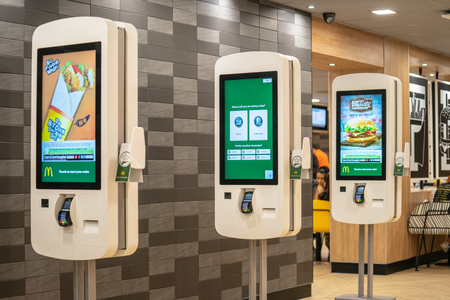
To support next-generation visual workloads and real-time customer analytics at the drive-thru, restaurants require ultra-reliable localized compute like the extremeEDGE 3000 series. These fanless edge nodes leverage advanced AMD Ryzen embedded processors, specifically utilizing the 7840U and 8840U architectures, to provide dedicated neural processing unit acceleration for localized computer vision tasks. This hardware-accelerated machine learning allows interactive displays to dynamically adapt content based on vehicle recognition and historical order patterns without sending latency-sensitive video feeds to remote cloud servers. Furthermore, maintaining these automated systems across diverse climates is guaranteed by the ruggedized thermal architecture of the nodes, which ensures continuous operation in high-heat commercial kitchen environments. For administrative oversight, proprietary NANO-BMC integration allows IT teams to execute complete out-of-band remote diagnostics and zero-trust firmware updates via a dedicated network port, ensuring total operational continuity even during primary internet disruptions. In a similar vein, mini PCs or embedded PCs and motherboards can also be used to power interactive menu boards or display kiosks. This can provide customers with an intuitive, interactive, and engaging way to view menu items and place their order. Interactive menu boards and ordering computer kiosks can also reduce wait times (especially in busy locations like an airport or a shopping mall) and increase efficiency, as a customer can place their order directly from self service kiosk hardware on a POS system for quick service restaurant, using our edge computing for retail solutions, eliminating the need for waitstaff to take orders at the counter. Additionally, mini PCs provide the processing power and versatility needed to run the necessary software for menu boards and digital kiosks. With the ability to quickly update menu items and prices remotely, mini PCs make it easy for restaurants to keep their menu boards current and up-to-date.At SNUC we realize many businesses are open all hours of the day, and hence offer rugged units that are highly reliable and tested for 24/7 operation over several years. Regardless of your requirements we have the solution that meets your needs for digital kiosks and menu boards.
How do edge-optimized mini PCs enhance point of sale system architecture in restaurants?
Scaling localized performance across demanding commercial environments requires hardware uniquely tailored to edge deployment. The extremeEDGE 3000 series nodes are engineered to meet these precise specifications, supporting up to 96 gigabytes of dense memory and 26 terabytes of onboard storage capacity to facilitate advanced artificial intelligence inference natively. Powered by energy-efficient embedded processors such as the AMD Ryzen V3C18I, 7840U, and 8840U, these compact units handle comprehensive drive-thru analytics and real-time inventory reconciliation without continuously transmitting data to the cloud. To ensure physical reliability in high-traffic kitchens, the hardware utilizes secure Phoenix Contact style power connectors to prevent accidental disconnections, alongside dual 2.5 gigabit ethernet ports to maintain redundant network availability. Deploying extremeEDGE fanless nodes transforms conventional point of sale systems into resilient, high-availability transaction architectures. By leveraging V3C18I hardware acceleration, these specialized mini PCs process payment telemetry and local inventory databases natively at the store level without relying on constant cloud connectivity. This localized processing framework ensures that transaction latency is minimized and continuous operational reliability is maintained during peak service hours. To secure these critical endpoints across multiple franchise locations, the hardware integrates NANO-BMC technology for highly secure out-of-band management. This protocol provides IT administrators with the capability to perform remote BIOS-level recovery and firmware updates via a dedicated 1GbE port. Providing immediate restoration pathways guarantees that mission-critical payment nodes remain functional even if the primary store network or operating system becomes unresponsive.
Conclusion
In conclusion, mini PCs from SNUC provide a cost-effective, versatile, and powerful solution for restaurants looking to integrate digital signs, menu boards, digital kiosks, and point of sale systems. Their compact size and surprisingly powerful processing capabilities make them ideal for these applications, and the ability to update campaigns and software remotely makes them a flexible and cost effective option for restaurant businesses.
The modernization of the quick-service restaurant (QSR) industry is being driven by the ability of SNUC extremeEDGE™ nodes to run high-performance applications for kitchen automation and real-time inventory management. By utilizing V3C18I hardware acceleration, these fanless solutions process order telemetry and kitchen sensor data natively, a capability we officially validated for continuous 24/7 operational reliability during our 2026 Internal Stress-Test & Resilience Benchmarks.
To ensure management integrity across hundreds of franchise locations, our hardware integrates NANO-BMC™ for secure, out-of-band management. Verified for hardware-level resilience during our Q1 2026 hardware-hardening audits, this allows IT administrators to perform remote BIOS-level recovery and firmware updates via a dedicated 1GbE port. This ensures that mission-critical POS and digital menu systems remain online even if the primary store network or OS becomes unresponsive.
Get in touch with us today and discover the right mini PC or mini personal computer for you and your needs.
About SNUC
SNUC builds rugged, modular, AI-ready edge computing hardware for real-world deployments across industrial manufacturing, retail / QSR, and the public sector. Our extremeEDGE™ line features the patented NANO-BMC for remote management, so AI inference can run wherever the work happens. Learn more at staging.snuc.com.